The Education of Kurdish Language
Modern formal schooling, which is usually structured in the form of primary, secondary and higher education, relies on the extensive use of written and oral language. To achieve any degree of success, the teaching/learning process must be carried out through a standard medium of instruction. In fact, school functions, and is generally accepted, as the most visible authority on the accepted "norm" of the language. The idea of "correctness" in writing and speech is associated with the teacher and the textbook. Many hours throughout a student's school life are devoted to learning grammar, spelling, composition and other language skills. This language training is more intensive in the lower school levels, although it extends, quite often, into higher educational institutions.
Besides this unifying/normalizing function, the educational system is a powerful source of functional and stylistic differentiation of the standard language. This is especially true at the higher level, where advanced knowledge is taught and developed. College-level textbooks and academic research journals demand a refined prose, advanced specialized vocabulary and special styles of writing.
The linguistic and intellectual homogenizing function of formal education makes it an ideal tool for political integration generally and assimilation of ethnic minorities particularly. Modern education, especially in the developing countries, has turned into a colossal social institution that is usually not responsive to minority demands for native-tongue instruction.
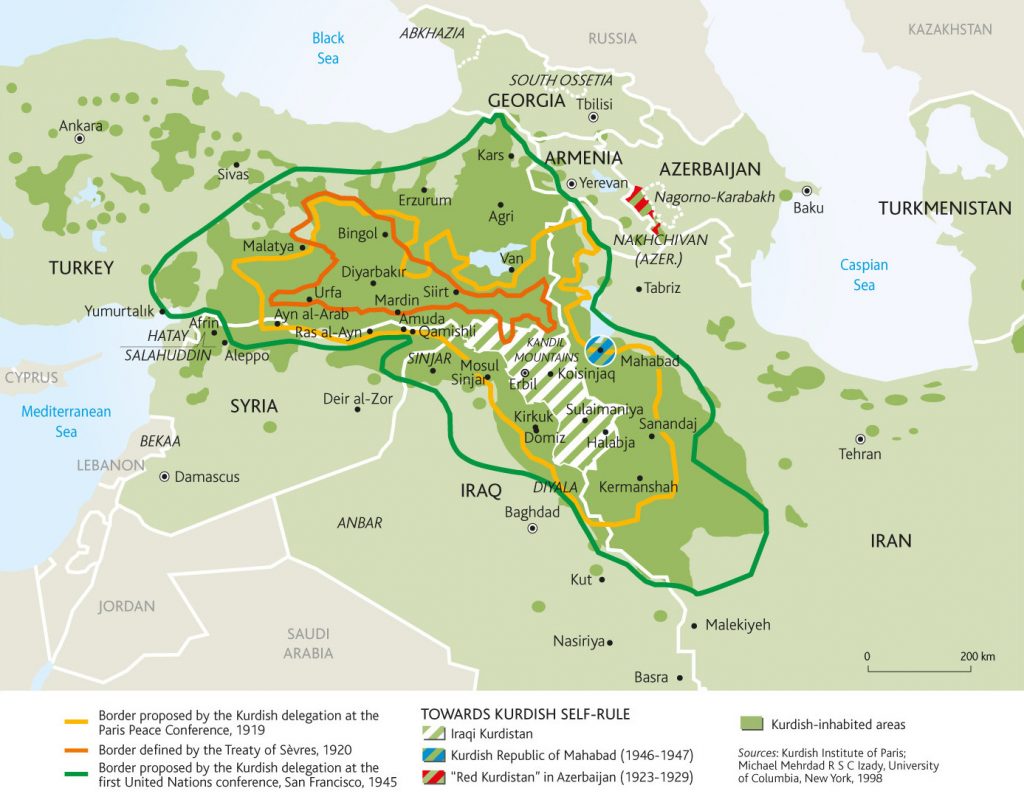
The purpose of this section is to document and analyze the development of native tongue education and its role in standardizing the Kurdish language, especially in Iraq (Iraqi Kurdistan where Kurdish found its way to education school system). As will be seen, both the central governments and the Kurds were aware of the linguistic and broader political implications of native tongue education, which has become and continues to be a major conflict between the two sides.
Kurdish Language Education in Iraq
Modern education in Iraq, as in other countries examined in this study, is the prerogative of the state. Individuals or minority groups are not allowed to establish schools or any type of educational institution without government permission, which is usually not granted.
The Mandate Period, 1920-32
After the occupation of Baghdad in 1917, the British authorities began to reorganize the educational system that the Ottoman Turks had established on the basis of European, chiefly French models. One change was in the medium of instruction, which had formerly been in Turkish. According to an official report, "Arabic, or the local vernacular in places where Kurdish, Turkish, Persian, or Syriac [Assyrian] was spoken, was adopted as the medium of instruction" (G.B. 1923-4:201).
Kurdish as Vernacular
From the very start, the British authorities assigned non-Arabic languages spoken in Iraq an inferior status. The official reports invariably refer to Kurdish, Turkish, Armenian, Assyrian, and Hebrew as "vernaculars" (e.g., Ibid. G.B. 1920-31:230). Elsewhere, it is stated that the government "committed itself to the principle of vernacular teaching in Kurdistan" (G.B. 1925:139).
According to this principle of "teaching in the vernacular," Kurdish was used as a medium of instruction only at the primary school level, while students were also taught the Arabic language so that they might continue their education in this language. In spite of continued protest by the Kurds, who demanded the use of Kurdish on all educational levels, various Iraqi regimes refused to allow secondary education in the language until the 1970s.
The League of Nations awarded the disputed province of Mosul to Iraq in 1925 on the condition that, among other things, Kurdish became "the official language" of "teaching in the schools" (cf. 5.1.2). Henceforth, demands for unrestricted use of the language in education grew stronger. However, both the Mandate authorities and the Arab government they had set up in Baghdad insisted on the vernacular policy:
...within the last month those Kurds who would have been content with primary education in Kurdish, are now pressing for Kurdish Secondary Schools and a Kurdish Training College. This will mean the duplication of instructions already existing in Baghdad, and therefore will involve heavy expenditure. Besides the economic difficulty there is also a serious mechanical difficulty. Kurdish has hitherto been a spoken rather than a written language, and there are practically no Kurdish books. In the early stages of primary education this is not such a serious defect, but something must be done to meet it in the case of secondary schools. And it is not simply the question of translation that is involved. There is before that the question of transliteration which presents serious difficulties.
Possibly the solution of the problem is to be found in the provision of primary education in Kurdish, at the same time making the study of Arabic as a second language obligatory, and increasing it progressively in the higher primary classes, so that a boy who passes out of a Kurdish primary school would be equipped for an Arabic secondary school. (G.B. 1925:139)
The arguments-i.e., the unsuitability of Kurdish for post-primary school education and the government's financial difficulties-were rejected by the Kurds (cf. below), who continued to press for equality between Arabic and Kurdish in education. The Mandatory power, for its part, continued to justify the policy in the Annual Report to the League of Nations:
G. B. (1926:129):
The principle has not been abandoned that Arabic should be studied as a second language up to a high standard of proficiency.
G.B. (1927:157):
The Iraq Government quite rightly insists on the maintenance of Arabic as a second language in the Kurdish schools. This is in the interests of the Kurds themselves. If the Kurds would accept this condition with a good grace and concentrate on the standardization of the Kurdish language and the creation of Kurdish school books, their cause would prosper better than it does. As it is, their parochialism has sometimes given openings to their opponents, and embarrassments to their friends.
G.B. (1928:132):
It is ... a matter for regret that the standard of Arabic in Kurdish schools is not so high as it should be. Neither legislation nor pledges can save the Kurds from the disadvantages bound to result from ignorance of the official language of the Central Government.
The conflict attracted the attention of the Permanent Mandates Commission in Geneva during the examination of the 1928 annual report. Referring to the annual report's statement, which claimed that the government did not afford separate colleges and schools for the Kurds (cf. quotation below, under B), a commission member proposed a system of bilingual education to meet Kurdish demands:
Mlle. Dannevig [Member of PMC] pointed out that the Kurds and Assyrians had complained that there were few educational facilities for them (see page 132 of report). Could facilities be given to the Kurds in the higher Arab schools by instituting bilingual teaching in them?
Mr. Bourdillon [Representative of the British Mandate] replied that it was generally agreed that Kurdish higher education ought to be in Arabic because the language was useful to the Kurds and all the textbooks were in Arabic. (I..N., PMC1921:45)
The Kurdish magazine Zarî Kîrmancî (No. 23, June 4, 1930, p.I) quoted the above conversation and questioned the usefulness of the Arabic language to the Kurds. The magazine article claimed that the Kurdish 'timid (clergy) were more proficient in Arabic than those of Arabia and had compiled more books in the traditional sciences while the Kurdish student in modern schools and in studying modern sciences had never made any use of Arabic. The journal concluded that it was more useful for the Kurdish children to learn European languages while studying in Kurdish.
Nationalism and Education in the Mother Tongue
The available evidence suggests that Kurdish political and intellectual leaders regarded full native tongue education as an indispensable tool of national consolidation and a sure way to resist the assimilation efforts of the central government. For their part, the central government considered education in Arabic a necessary means of integrating the independence-seeking Kurds. "Kurdish education" thus turned into a battlefield throughout the Mandate period (cf. Sluglett 1976:182-95, 199-206, 211-16), and has continued to be a major demand of the Kurdish nationalist movement. An examination of the positions and actions of both sides throws some light on the way non-linguistic obstacles affect the standardization process.
A. Education and Language Development
Representing the Kurdish opinion of the time, Kurdish historian Zaki (1935:59), then Deputy in the Chamber, complained to the Higher Commissioner that "limiting the teaching of Kurdish to elementary and primary school level will hinder the progress and development of the Kurdish language" (cf. 5.1.6 on other language related issues raised by Zaki). He further rejected the argument that Kurdish was unsuitable for teaching and writing and noted that the holders of this view were uninformed about several centuries of historical, linguistic, literary and religious writing. Zaki claimed that Kurdish was even richer than Persian and, as such, the defect ascribed to Kurdish was not to be found in the language but rather in the conditions that had not given it "...a chance to be used and to gradually get reformed and developed" (pp. 59-60).
To develop both the language and education in it, seven Kurdish members of the Chamber of Deputies submitted a petition to the Minister of Education on June 1, 1928 in which they outlined seven "most important causes of the retrogression of education" in Kurdistan and sought to remove them by:
- establishing a "Translation and Compilation Committee" for preparing school textbooks;
- devoting enough funds for hiring competent and readily available teachers for secondary schools and a Teacher Training College;
- forming a single Kurdish education office and inspectorate in charge of all Kurdish areas;
- the completion of incomplete secondary schools and the opening of new ones, all using Kurdish as the medium of instruction, but teaching Arabic as a second language;
- establishing a Teacher Training College in Kurdistan; and
- opening schools for females (text of petition in Zarî Kirmancî, No. 5, November 11, 1928, pp. 4-7).
Addressing these and similar demands, the Mandate's 1929 annual report to the League of Nations reiterated government policy (G.B. 1929:139-40):
The opening of three new Kurdish elementary schools has not appeased the discontent of the Kurds with the general educational policy of the Government. This discontent takes the form of complaining: -
- that there are not enough Kurdish elementary schools,
- that there is no Kurdish training college,
- that there are not enough school books in Kurdish,
- that the Kurdish schools are handicapped by not being under a separate Kurdish education area.
A fair answer to these complaints is that (a), if true of Kurdistan, is equally true of the Arab speaking areas; (b) that a separate training college is neither practicable nor in the interests of the Kurds themselves; that (c) is true, but is becoming less true every year; that (d) is a reasonable complaint which certainly should be redressed. If it were redressed probably all the other grievances would disappear.
Administrative reorganization of education was not, however, the central issue so far as the Kurdish sources indicate. The main question was teaching in the native tongue. The nationalist figure, Huzni Mukriyani, suggested in his magazine Zarî Kirmancî (No.2, 1926, p. 18) that remaining uneducated was better than receiving education in a foreign tongue:
Between Son and Father
Son: Father, why do you write in your mother tongue?
Father: Son, it is binding on us to write and read in our language.
Son: Then, why they do not teach us in the language?
Father: It should not be [like that]; I send you to school to be taught in your own language.
Son: I like it but my teacher teaches me in another language which I don't understand and find very difficult.
Father: If this is the case, I won't let you go to school.
Son: No, I'll go and study; it is better than ignorance.
Father: You had better become a shepherd, [Or] do ploughing for me. These are better than taking lessons and not understanding them.
Son: You are in enmity with education and knowledge; you do not appreciate progress, that is why you prevent me from going to school.
Father: My dear son, I like education and I am not an enemy of knowledge and enlightenment, but it is better for you to remain ignorant than to be unaware of your identity, not to study in your language and to serve the strangers...
B. The Demand for Schools.
Next to full native tongue education were demands for extending education to all Kurdish areas and for the provision of schools, teachers, budget and facilities on the basis of proportionality, i.e., a share of 17%, according to the official estimate of the percentage of the Kurdish population of Iraq. Here, too, complaints were always made that Kurds did not receive their just share. A representative official response was the following (G.B. 1928:132):
The opening of 5 new primary or elementary schools in the course of the year in Kurdish areas has satisfied everyone except the Kurds themselves. It is not easy to hold a just balance between the claims of Kurdish and Arab areas for new schools, or to persuade the responsible authorities that the number of pupils is not the only justification for the opening of a new school. If it were so, the Arab areas would get a larger share of new schools than they actually do get. Another difficulty is that whereas the Government holds that the present 30 Kurdish primary and secondary schools represents the maximum to which the Kurds are entitled, most Kurds regard, or profess to regard, this as a minimum. Yet apart from questions of right or wrong, it is clear that the country cannot at present afford a separate training college and separate higher schools for Kurdistan, even if such were proved to be in the interests of the Kurds themselves.
According to the data taken from the Annual Reports, however, the Kurdish share of primary/elementary schools was not larger than 11.43% (cf. Table 51).
Table 51. Number and Proportion of Kurdish Schools in Iraq, 1923-30
a. Figure obtained by adding 4 new schools to the 15 of the previous year.
b. Figure obtained by adding 5 new schools to the 19 of the previous year.
c. Figure given in the Report is 30 which include two intermediate schools with instruction in Arabic.
d. Figure obtained by adding 3 new schools to the 28 of the previous year.
e. The decline is apparently due to the Arabization of the Kurdish schools of Mosul liwa.
* Annual Reports are cited under G.B. in the Bibliography.
Least convincing to the Kurds was the government's financial arguments against the provision of more schools. Quoting the latest statistics available, Zaki (1935:62) told the Chamber of Deputies in August 1928 that of the total amount of rupees spent on schools, 4.4 % were devoted to Kurdistan where the population was 17%, while the Turkmen share was 3%, although their population was 8% and Arabs and others got 92.6% with a population of 81 %. In the same year (1927), the government had spent only 1 % of the revenues from Sulaymaniya and 2.50% of those from Arbil on education in these liwas, whereas the allocation for Arab liwas was 38% (Baghdad), 18% (Karbala) and 21% for Basra.
Another limitation on Kurdish education was the government's reluctance to introduce Kurdish into the old or newly-established schools of some Kurdish areas. Zaki (1935) showed that only three out of 20 schools (15%) were Kurdish in Kirkuk liwa, whereas 51 % of the population were Kurds. The remaining schools, "except one or two" (i.e., 75% to 80%), taught in Turkish, which was the language of no more than 21½ %. There were no Kurdish schools in Kirkuk city. According to Zaki, the situation "pushes the Kurdish inhabitants either to refuse to send their children to school since they do not want to accept Turkish, or to do so unwillingly... That the government lets this strange situation prevail cannot be interpreted except by the government's wish to encourage their [the Turk's] language and its spread in order to harm the Kurds..." (pp. 18-19).
Arabization of Kurdish Education
The connection between Kurdish nationalism and the demand for mother tongue education was well known to both the Arab government and the British Mandate authorities who, as an overall policy of curbing this nationalism, tried to restrict instruction in the language.
In his statement to the sixteenth meeting of the League of Nation's Permanent Mandates Commission (June 18, 1931), Sir Francis Humphrys, High Commissioner for Iraq, said:
I found that there was a unanimous desire among all responsible Kurds for improved educational facilities. They are clearly awakening to the fact that the Arabs are moving far ahead of them in education and learning and they fear that, unless they can speed up their own educational developments, they will in a few years, in spite of any statutory safeguards which may be devised for them, drop into the position of a backward and ignorant minority. (LN., PMC. 1931a:120)
Instead of "statutory safeguards," Kurdish sources of the period report the increasing Arabization of the primary schools, especially in the Mosul, Kirkuk, and Arbil liwas. Arabization was carried out through various channels, e.g., changing textbooks, appointing non-Kurdish teachers, alluring students to shift to Arabic, and direct Arabization of the schools. The policy of appointing non-Kurdish teachers was denounced by the Kurds as early as 1926. Zarî Kirmancî (No. 1, May 24, 1926, p. 16) indirectly criticized the government in a dialogue in which the teacher talks in a mixed Turkish/Kurdish language and the student complains that he does not understand him:
Student: By God, you don't know any Kurdish because you are not a Kurd.
Teacher: You are right; it is about a year since I have become a Kurd to make a living.
Student: What can a Kurdish child learn from you who are disguised as a Kurd, when no one even knows where you are from?
The same magazine reported Arabization of schools in Arbil: "Certain measures have been taken in order not to teach in Kurdish but to teach in... [Arabic] from the very first year-these are being done very delicately... The students are deceived by [promises of] promotion and are regularly sent to the Jewish schools. The Jews are not aware of it..." (Zarî Kirmancî, No. 21, April 6, 1930, p.1). It was also noted that a Kurdish school in Kirkuk had been closed down and was not reopened "in spite of all efforts made." Kurdish students had to learn Turkish for four years and then switch to Arabic. This had resulted in the students' failure to enter the post-secondary schools of Baghdad in the past two years (No. 19, May 26, 1929, p. 10).
Similarly, Zaki (1935:20) complained to King Faisal in December 1930 about "the complete removal of the Kurdish language from all the five qadhas [of Mosul] by the Ministry of Education." Zaki, then a member of the Chamber of Deputies, said that he did not know whether the measure was taken by the Minister of Education himself or by the order of the government. We know now, through the confidential correspondence of the time, that Arabization was a policy pursued by both the Arab government and the Mandate authorities. The Arabization of schools in Mosul liwa was decided by the Minister of Interior, 'Abd al-'Aziz al-Qasab, as early as 1926, with the knowledge and consent of the Mandate authorities. Sir Henry Dobbs, High Commissioner, wrote to Cornwallis on June 25, 1926 that the Minister
"suggested that an order should quietly issue with regard to the Mosul Liwa schools that Arabic textbooks should be used, as being better drawn up and more suitable for the purposes of instruction, and that wherever the pupils do not understand Arabic the teacher should explain and translate to them in the Kurdish language. He thinks there would be no clamour over this. New schools in the Mosul Liwa should have instruction in the Arabic tongue. (quoted in Sluglett 1976:184; emphasis added)"
The mandate authorities justified this policy in language acceptable to the League of Nations:
It has been felt that the Kurdish language alone provides too narrow a basis for secondary and higher education. The government has therefore always insisted that Arabic shall be studied in Kurdish primary schools, and in the intermediate schools of Arbil and Sulaymaniya a gradual change over is made from Kurdish to Arabic as the medium of instruction. This example has even been followed by some Kurdish elementary and primary schools in the Mosul Liwa where Kurdish nationalism is less active. In these, Arabic text books are used from the beginning, though Kurdish is the language of instruction and explanation. (G.B. 1920-31:230; emphasis added)
While a few Mandate officials privately showed concern about promises made to the Kurds, the general policy was to disguise and/or justify Arabization at the League of Nations. Thus, when asked "whether the secondary school at Sulaymaniya was Kurdish," the British representative at the Permanent Mandates Commission answered that "the school at Sulaymamya came under the provision of the new Language law, but the education there had always been given in Kurdish, the language of the majority of the pupils" (November 11, 1930; LN., PMC. 1930:105). It must be noted, however, that at this time the Language Law had not passed through the Parliament, while both its draft and final version limited Kurdish language instruction to the primary school level (cf. 5.1.4).
In a secret note on "The Kurdish Question" submitted to the High Commissioner on May 12, 1929, C.1. Edmonds pointed out that promises made to the Kurds had been ignored by "various authorities, both British and Iraqi." Typical cases of "short-sighted activity" of the Ministry of Education were cited:
(a) the attempt to persuade the people of Sulaimani to accept the use of Arabic instead of Kurdish as the medium of instruction in the secondary schools, (b) the refusal to give Arbil a secondary school unless the people agreed to Arabic as the medium of instruction, (c) the subsequent attempt to change the language of instruction in the 5th and 6th primary classes at Arbil from Kurdish to Arabic, (d) exclusion of Kurdish from the Girl's school at Arbil, (e) the inordinate delay in approving Kurdish school books submitted to the Ministry and the failure to appoint whole time men to translate existing books, and so on. ("The Kurdish Question," No. S.A. 321 of May 12, 1929, Delhi, BHCF. Events in Kurdistan, Kurdish Policy, File No. 13/14, Vol. VI, Secret)
The Scope of Instruction in Kurdish
According to the syllabus of the primary course of study of 1928, which was in use at least until 1942, twelve "subjects" were taught in the six grades of Arabic language primary schools: Religion (20 "lessons," i.e., hours per week), Arabic (49), Arithmetic and Geometry (34), Geography and History (18), Objects Lesson [natural science] and Health (12), Civic and Moral Information (12), English (18), Arabic Penmanship (9), Drawing and Manual Training (13), Physical Education (11) and Singing (5) making a total of 192 hours.
According to Akrawi (1942:181, 197), this regular course of study was modified for Kurdish and Turkish schools-Mathematics, Geography, Objects Lessons, and Civics and Morals were to be taught in Kurdish. Singing classes were both in Arabic and Kurdish; also, the periods given to Arabic language (49) and Arabic Penmanship (9) were divided between Kurdish and Arabic (cf. Table 52).
Tile share in the total 49 hours of language instruction was 26.5%. It seems, therefore, that the syllabus aimed at providing enough time to teach Arabic to Kurdish students at the expense of proficiency in Kurdish. Penmanship classes did not present any problem since the two scripts are, except for Kurdish diacritics, the same (two out of three penmanship periods in each of the second, third and fourth grades were devoted to Kurdish).
Table 52: Teaching Arabic and Kurdish in Primary Schools of Kurdistan, Iraq, 1928
Source: Based on Akrawi (1942:181, 197)
Kurdish Education in the Monarchical Period, 1932-58
The number of schools which used Kurdish as the medium of instruction is not indicated in the annual educational statistics or in the annual statistical abstracts. According to Kurdish sources, Arabization continued throughout the period. To cite a few examples, Arbil's Rûnakî (No. 3, November 29, 1935, p. 8) wrote on the change of textbooks into Arabic, calling it "Chaldean" apparently to avoid censorship:
Farther and Son
Son: I have to get a book.
Father: I got you one yesterday.
Son: Not a Kurdish book! One in Chaldean.
Father: What is that'?
Son: This has become the new curriculum in school.
By 1957, all girls' schools in Sulaymaniya were taught in Arabic (Jîn, September 12, 1957). There was only one Kurdish school in Arbil and one in Kirkuk liwa (Nebez 1957:41-42). In the few remaining schools, instruction was increasingly conducted in Arabic. At one time, even singing was done in Arabic in Sulaymaniya schools (Ibid., p. 42) and some teachers taught other subjects during hours assigned for Kurdish language study (Jîn, February 18, 1954). A secondary school teacher, Jemal Nebez, was told by Kirkuk education authorities not to use Kurdish in his teaching since it was not "an official language." He continued explaining the science courses in Kurdish, however, and was finally removed from Kirkuk and reappointed to the Arab port of Basra in October 1957 (Nebez 1976: 16).
By the 1950s it had become apparent that the Arabic-oriented curriculum had put Kurdish in a disadvantaged position. Students were more proficient in Arabic than in Kurdish. At Sulaymaniya, one substitute teacher found that sixth graders failed to answer when asked how Kurdish and Arabic writing differed or which Kurdish letters did not have Arabic counterparts. When asked to name some Kurdish poets, most of them mentioned the names of singers on the radio. This was, according to Jîn (February 18, 1954), due to the fact that Kurdish composition, literature, and history were not part of the curriculum.
Another problem was the inability of some, among them Kurdish, teachers to teach in Kurdish, apparently because they had themselves received education in Arabic and found it difficult to make the transition. Thus, in spite of the protest of students in the girls' schools of Sulaymaniya, teachers continued to teach in Arabic (Jîn, September 12, 1957). It was the government, however, that was blamed the most for ignoring the Local Languages Law and encouraging teachers to neglect mother tongue instruction (Jîn, February 18, 1954).
Kurdish Education in Republican Iraq
The 1958-61 Period
Education expanded rapidly under the new republican regime. By the academic year 1961-62, the number of primary schools in Iraq had increased by 94.5 % (3,963 schools) over 1957-8. Similarly, schools in Sulaymaniya recorded an increase of 84.4% (232 schools), Arbil 130.7% (240 schools), Kirkuk 173.6% (342 schools), and Mosul 84.7% (449 schools). The language of instruction is not indicated in the statistical sources (figures based on Iraq Republic 1959:17 and 1961-62:14).
To be continued..
Source: Dr. Amir Hassanpour, "Nationalism and Language in Kurdistan 1918-1985", 1992.
|